Adana kebab is hand-minced, never ground. That one difference is most of what separates it from every other skewer on a grill, and it is the first thing a Turkish guest looks for.
The name is a place. Adana sits on the Çukurova plain in southern Turkey, hot most of the year, surrounded by farmland and pepper fields. The kebab carries the city’s name because the city made it, and in Turkey that name is not decoration. It comes with rules.
That is the part most menus outside Turkey leave out. Adana kebab is not a category of grilled meat. It is one specific dish, made one specific way, and Turkish people are particular about it for reasons worth understanding. The same thing happens with doner, which is a story we have told before.
Hand-minced, not ground
Start with the blade.
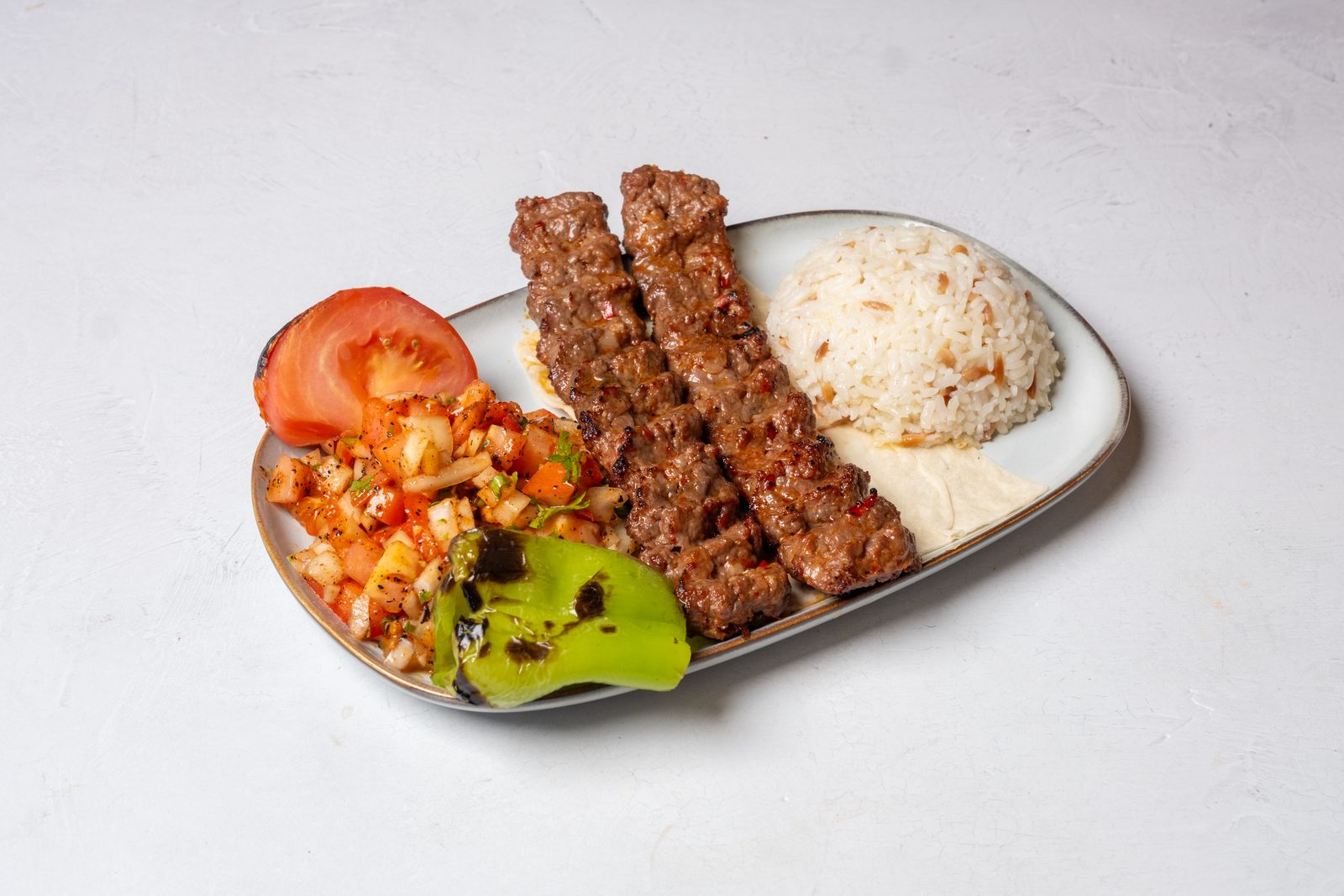
Traditional Adana is made with a zırh, a heavy curved knife that the cook rocks across the meat on a wooden board until it breaks down. This is slow work. A grinder would do it in seconds.
The grinder is the problem. It crushes and smears the meat, pushing fat and fiber into paste. The zırh cuts. The muscle stays open, the fat stays in visible pieces rather than dissolving into the mix, and the kebab holds a loose texture that you can feel between your teeth. Ground meat gives you a smooth, dense skewer. Hand-minced gives you something else entirely.
The meat is lamb. The fat is tail fat, folded in at a set proportion, because the fat is what bastes the skewer over open coals and keeps the meat from drying into a stick.
The heat is not optional
Adana is spicy. That is not a preference or a style choice, it is the definition.
Red pepper from the region goes into the mix, and the finished kebab carries real heat. If a kebab is made the same way but left mild, it has a different name. That is Urfa kebab, from Şanlıurfa, a few hours east. Same shape, same technique, same skewer. Different city, different name, because the heat is what separates them.
So when a menu offers a mild Adana, it is offering an Urfa and calling it something else. Small detail. Turkish guests notice it immediately.
A dish with rules
Here is the thing that says the most about how Turkish culture treats food: Adana kebab is a registered name in Turkey, held by the Adana Chamber of Commerce.
The registration works the way it does for a regional cheese or a wine. It sets out what the dish is: the animal, the cut, the proportion of fat, the hand-mincing, the flat wide skewer, the charcoal. Meet the spec and you can call it Adana kebab. Miss it and you are making something else.
What it protects is the method rather than the address. The registration is an indication of source, not an appellation, which means the dish is defined by how it is made and not by a fence around the city limits. Follow the method and you are making Adana kebab. That is the whole point of writing the method down.
Think about what that requires. A city had to decide this dish was worth defining. Producers had to agree on the details. A national body had to write it down and enforce it.
Countries do that for things they consider part of who they are. In Turkey, food is not a lifestyle interest sitting off to the side of the culture. It is the culture, and recipes are treated as inheritance rather than trend. Adana kebab got legal protection for the same reason a family recipe gets passed down without changes: the way it is made is the point, and altering it makes it a different thing.
That is also why a Turkish guest will send back a kebab that misses. They are not being difficult. They are holding a standard someone wrote down on purpose.
What comes with it
An Adana kebab is not served alone, and it is not meant to be eaten alone.
The skewer comes off the coals onto lavash, which soaks up the fat as it rests. Next to it: a grilled tomato and a long green pepper, blistered on the same grill. Onions tossed with sumac and parsley, sharp enough to cut the richness. Ezme if the kitchen makes it well. Ayran to drink, cold and salty.
You tear the bread, take some meat, add onion, and eat with your hands. Everyone at the table does the same thing at the same time. In Turkey the room this happens in is usually an ocakbaşı, where the grill sits in the middle and everyone faces it. The cooking is not hidden in a back kitchen. It happens in front of you, which is its own kind of hospitality.
That is what the dish carries with it: a table, not a plate.
Adana at Doner Point
Our Adana is lamb, and it is spicy. Halal certified, like everything else we serve. Grilled over the fire when you order it, not held and reheated.
You will find it at two of our locations.
Edgewater, NJ serves the Adana Kebab plate. See the full Edgewater menu.
Richardson, TX serves the Adana plate, an Adana wrap, Adana beyti wrapped in lavash, a chicken Adana, and lahmacun with Adana. See the full Richardson menu.
Come hungry, and bring people. It is a dish that works better with a full table. If you would rather eat it at home, you can order online.
Edgewater
820 River Rd, Edgewater, NJ 07020
(201) 267-3801
Richardson
1840 N Plano Rd, Richardson, TX 75081
(214) 272-3878